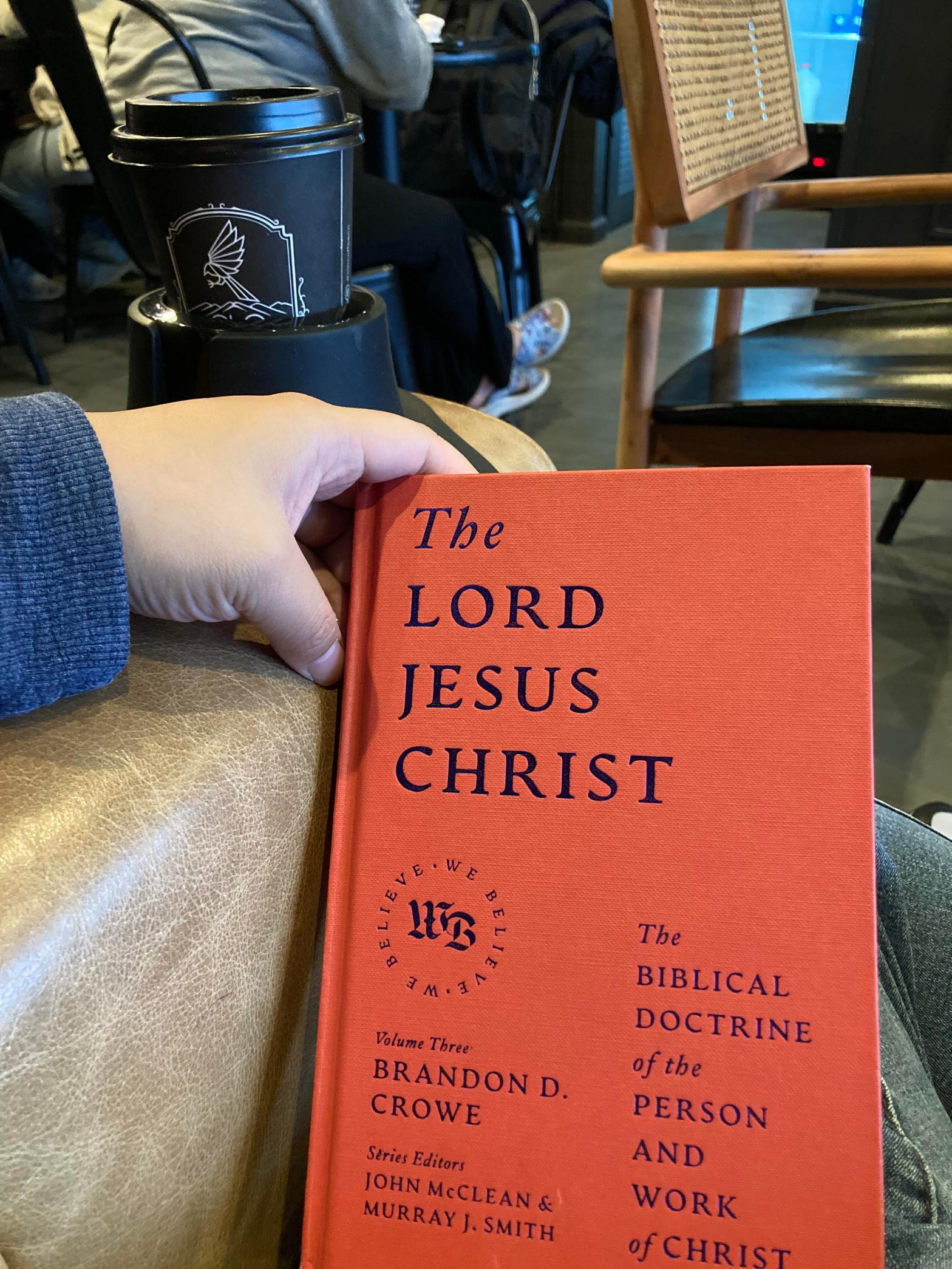
Crowe, Brandon D. The Lord Jesus Christ: The Biblical Doctrine of the Person and Work of Christ. Bellingham, WA: Lexham Academic, 2023.
Author and Volume Series
Brandon Crowe, a scholar in the fields of the New Testament, biblical theology, and the early church, offers his extensive knowledge and experience in this book on Christology. Crowe is the NT professor at Westminster Theological Seminary in Glenside, PA. His academic achievements, including a PhD. in NT and Christian Origins from the University of Edinburgh and an MDiv from Reformed Theological Seminary, Orlando, FL, further attest to his credibility. His numerous publications, from journal articles to co-authored works, delve into the triune God, theology proper, and especially Christology, topics such as Christ’s passive and active obedience, humiliation and exaltation, and munus triplex—prophet, priest, and king.
Crowe’s The Lord Jesus Christ, part of Lexham Press’ ‘We Believe’ series, has a distinct methodology. It is structured into three parts, each serving a distinct purpose: Part 1 delves into Biblical revelation, Part 2 explores Dogmatic development, and Part 3 offers Truth for Worship, Life, and Mission. This approach seamlessly transitions from biblical theology to systematic theology, culminating in doxological, ethical, and missional implications.
Summary
Brandon Crowe introduces his work by asking Christ’s question to his disciples, “Who do you say that I am?” This book aims to answer this question. Though Crowe intends to keep this work as an introduction to Christology, he gives a comprehensive account of biblical exegesis, historical theology, and dogmatics. Biblical revelation is the first part divided into five chapters, 1 to 5. It is biblical or exegetical theology in nature. An orthodox Christology is a recognition of the presence of the Son of God in the Old Testament and his pre-existence as the second person of the Trinity. The theme of sonship permeates the chapters in the first part of Crowe’s work. In the Creation account, “The Son of God was present and active” (11), and he is the mediator between the old covenant (or covenant of works) and the covenant of grace. The Sonship theme includes Adam, Israel, and David. These sonships find their fullness in the incarnation of the Son of God in Jesus Christ. This anticipation of the full revelation of the Son of God is evident through the exodus from Egypt, the levitical sacrificial system, and the interweaving organic theme of the munus triplex—the threefold office of prophet, priest, and king.
Extending from the Pentateuch, the fuller revelation of the Son of God in Jesus Christ was also anticipated in the writings of the Prophets and wholly fulfilled in the Gospels, Paul’s letters, and Revelation. Crowe offers more exegesis of the NT writers by presenting Christ as the Son of God incarnate, the Lord and Savior, His exaltation and return. He concludes with another anticipation of Christ’s culminating return before the dogmatic development presentation.
Dogmatic development is the second part divided into six chapters from chapters 6 to 11. Chapters 6 and 7 deal with historical theology from the pre-Nicene writers and early defenders of the faith and the four ecumenical councils to the magisterial Reformation and selected modern Christological challenges. Crowe uncovers the theological gems from the writings of the postapostolic fathers like Ignatius of Antioch, Clement of Rome, and Polycarp of Smyrna. He then delves into the Christological understanding of the apologists and heresiologists like Justin Martyr, Irenaeus of Lyons, including other Latin-speaking and Greek-speaking early church fathers—Origen of Alexandria, Tertullian of Carthage, and Novation. The aim is simple but significant: even before the Nicene Christological formulation, the pre-Nicene fathers were already affirming—though not yet codified the theological terminologies—the hypostatic union (fully divine, fully human), communicatio idiomatum, munus triplex, impassibility, and regula fidei that resembles the Apostles’ Creed.
Chapter 7 presents the creedal language and development of Christological terminologies. While creeds, councils, and confessions are fundamental in Christological understanding, they are not the final authority for faith and practices but the Scriptures. Nevertheless, these terms are significant for “more precision… to articulate the truths about Christ from Scripture to avoid confusion, and to counter unbiblical views” (179). The following ecumenical creeds are the Nicene Creed in AD 325, with a follow-up of the Constantinopolitan Creed in AD 381. This creed’s highlight is affirming the deity of Christ and rejecting Arianism, Sabellianism, and Apollinarian heresies. The next is the Council of Ephesus in AD 431, which clarifies the communication of properties of the two natures as a counter to Nestorianism. The fourth is the Council of Chalcedon in AD 451. It seals the theology of hypostatic union, the two natures in one person, and denies Eutychianism. Skipping the Medieval era (which is somehow upsetting), the next section of this chapter tackles Christology in Reformation time, emphasizes justification by faith alone, the presence of Christ in the Lord’s Supper, and countering Scocinianism. Crowe discusses modern controversies about kenoticism, higher criticism, the historical Jesus movement, and enlightenment in the last section.
The latter part of the dogmatic development, chapters 8 to 11, deals initially with eternal generation, Christ as the mediator of the covenant of grace, and avoiding subordinationism of Christ to the Father (chapters 8 to 9). Crowe argues, “The Son submits in the economy of redemption; ontologically, he is not eternally subordinate to the Father” (213-4). Further chapters ground deeper in presenting hypostatic union—the two natures, divine and human, in one person of Jesus Christ. Grounding from the hypostatic union, Crowe proceeds to explain how the two natures relate to each other, which is called communicatio idiomatum. He continues with the possibility of true and unfallen humanity, miracles, and impeccability. Crowe solves the debates of extra Calvinisticum, the death of Christ, and open theism—did Jesus know the future?—through the theological formulation of the hypostatic union and communication of properties. Regarding the question, “Could the Son of God die?” Crowe answers, “Though the Son of God never ceases to exist, he does die in the economy of redemption with respect to his human nature that he took in the incarnation” (248).
While chapters 8 and 9 focus on Christ’s person or ontological aspect, chapter 10 emphasizes his works. Throughout Crowe’s work, the inseparable nature of Christ’s person and work is evident as he weaves it into his theological underpinnings. Crowe returns to the Christological theme of munus triplex as he presents Jesus’ humiliation and exaltation. As a prophet, Jesus is the “full-flowered word of God;” as a priest, Jesus offers himself as the ultimate sacrifice for his people; and as a king, Jesus inaugurates his rulership over the kingdom of God. He divides this chapter into two sections: humiliation and exaltation. In humiliation, Christ’s active and passive obedience is presented as divine satisfaction and his death, respectively. Crowe touches on the themes of atonement, imputed righteousness, the logic of the cross, burial, dereliction, and the question of the descent. In the atonement—leaning toward both Christus Victor and penal substitution—he argues, “There is no need to divide between Christ as the penal substitute for sin and Christ as the victorious king; these are held together on the cross” (263). The exaltation section is about the resurrection, ascension, glorification, outpouring of the Spirit, and the second coming of Christ with a rejection of rapture theology. Finally, in chapter 11, Crowe offers a Christ-centered biblical theological approach to reading the Scripture and a Christ-centered systematic theology. In brevity, covenantal theological reading is essential for Crowe’s hermeneutical and theological formulation.
Lastly, chapters 12 to 13 offer a practical theology for worship, life, and mission, including the conclusion of the seven theses on the person and work of Jesus Christ. The former chapter presents the gospel of Christ—“to believe the gospel is to believe in Christ himself” (296-7)—union with Christ and the essential part of gospel proclamation. The final chapter argues for the exclusivity of salvation in Christ alone. In today’s pluralistic world, it is countercultural to “claim exclusive devotion to Jesus and maintain a biblical ethic,” which was also a challenge in the first century (308). Crowe ends his work with his seven theses on the person and work of Christ—in brevity: (1) the eternality of the Son of God, (2) the incarnation, (3) hypostatic union, (4) the gospel is about the Son of God, (5) centrality of Christ in Scriptures, (6) essentiality of creeds, councils, and confessions, and (7) Jesus is the only Savior.
Review of the Work
The editorial’s methodological design is impressive and easy for the readers to follow—from biblical theology to dogmatic theology (historical and systematic) and ends with practical theology. In an interview, the author states that his audience in mind during the writing was seminarians, lay people, ministers of the Word, and professors who can use it as a textbook—in short, with biblical and theological training.[1] After reading this work, a personal suggestion, readers may approach it with a ‘faith-seeking understanding,’ wanting to know Jesus more. Each chapter builds from the previous chapter and transitions naturally to the next one. It makes the reader want to finish the book as soon as possible. It is exciting and edifying to read.
However, the last part—Truth for Worship, Life, and Mission—was anticlimactic. Even though Crowe notes in his introduction that it is briefer, it feels rushed and constrained by the limitations of time and the words for publication purposes. Indeed, Christ is worthy of worship. However, the section title states about worship, yet there is no doxological theme in the chapter. Likewise, it lacks ethical themes for Christian living.
Overall, Crowe’s work is a coherent and significant primer for Christology. Even though this book was written with Reformed leanings and expectations, it will benefit readers with at least an average biblical and theological training. There are biblical and theological languages that may seem difficult to understand for beginners. Providentially, a brief glossary will help guide other readers. Likewise, it is textbook material for seminary and bible schools.
[1] Brandon Crowe, “The Lord Jesus Christ,” Guilt Grace Gratitude Podcast, October 19, 2023, YouTube video, 15:15, https://youtu.be/St7xSySVsz8?si=2gxeCqVE775Em9qs&t=915.
 John&Paul's Reflections
One thought on “[Book Review] Brandon Crowe, The Lord Jesus Christ”