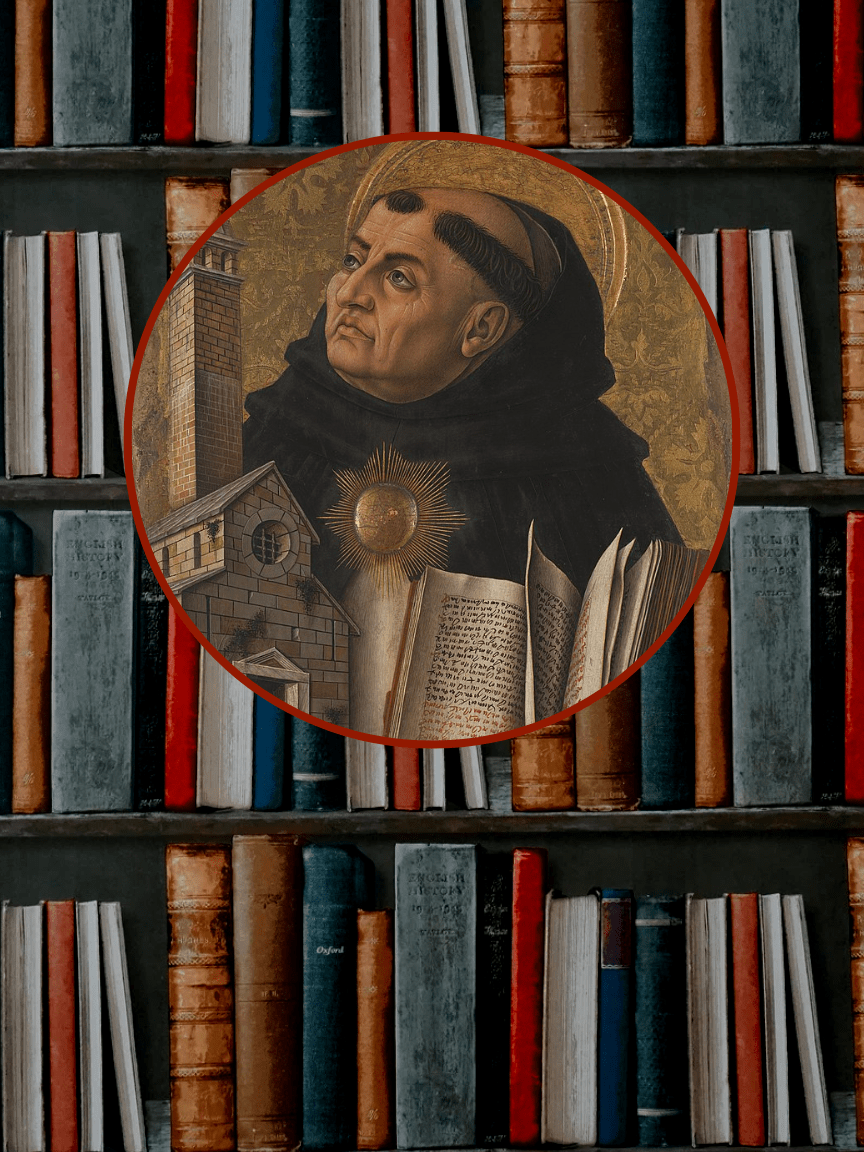
Saint Thomas Aquinas. Summa Theologica. Volume 1: QQ. 1-119. 1911; Reprinted, Westminster, MD: Christian Classics, 1948. Questions 1-26, pages 1-143.
Introduction and Method
This edition was originally published and translated into English in 1911, revised in 1920, and reissued in three volumes in 1948. The book in this review is a reprinted issue of Christian Classics, now under Ave Maria Press, in 1981 from the 1948 copyright by the Benziger Brothers, now Resources for Christian Living, RCL Benziger. Nevertheless, Thomas Aquinas’s Summa Theologica (henceforth, Summa) was unfinished due to his death in 1274. Aquinas began writing his Summa around 1265 and completed the first part (Prima Pars) before teaching at the University of Paris in 1269. The purpose of the Summa is to be a guide or textbook for theological students, specifically beginners. In the Prologue, Aquinas noted, “We purpose in this book to treat of whatever belongs to the Christian Religion, in such a way as may tend to the instruction of beginners” (xix).
Thomas Aquinas was born in 1225 in Roccasecca, Italy. At fifteen, he studied in Naples, where he encountered Aristotle’s works and Dominican life. He later caught the attention of the Dominican authorities; from 1252 to 1256, they offered him to study with Albert the Great at the University of Paris and later sent him to the University of Cologne in Germany for further study. Eventually, Aquinas taught theology and philosophy in Paris and Italy and wrote two of his greatest works, Summa Contra Gentiles and Summa Theologica. The latter Summa is the subject reviewed in this work but is only limited to Questions 1 to 26.
In 1273, Thomas received a powerful divine revelation that made him refuse to write again. It may be a glimpse of a beatific vision or a corporeal mystical vision of Christ. While it is uncertain what Thomas had experienced during this beatific vision, in his First Part of the Second Part (Prima Secundae Partis) Question 3, Article 4, stated, “Consequently, for perfect happiness the intellect needs to reach the very Essence of the First Cause. And thus it will have its perfection through union with God as with that object, in which alone man’s happiness consists.” This statement means that the most glorious and happiest time for a person was finally to be in union with God. Thomas receiving such corporeal beatific vision is truly a ‘jaw-dropping-knee-falling’ moment that caused him to compare all his works to nothing but a straw.[1] A year later, on March 7, 1274, he died without finishing his magnum opus, Summa.
Aquinas’s format of writing—the Thomistic method—can be divided into four parts: 1) Question, which describes the issue or inquiry; 2) Antithesis, which is a series of objections; 3) Thesis, which is the actual argument mainly started by citing authoritative works from the Bible, prominent Church Fathers, and Philosophers—like but not limited to Augustine, the Damascene, Ambrose, Origen, Aristotle, Plato, Boethius, and Dionysius; 4) Counter-Argument, which are individual replies refuting the objections stated in the Antithesis section. An excellent inquiry about this method is whether he begins formulating his theology with the Question or Theis.
Questions 1 to 26: A Summary
The Summa Theologica is a theological work by Thomas Aquinas surveying the Christian doctrine written in a philosophical, systematic, and scholastic manner. During Aquinas’ time, this work instantly became distinct due to its incorporation of Aristotelian philosophy, which was heavily evident throughout the Summa. Question 1 begins with the notion of the significance of studying sacred doctrine or theology. Theology is the study of God and divine matters related to God. It is a higher science understood through divine revelation, not natural reason. Reason through natural sciences can lead to an idea about someone supreme. But faith by grace perfects this idea about God. Aquinas noted, “Grace does not destroy nature, but perfects it” (6). The source of theology is the Scriptures; God is the author of the Holy Writ. Aquinas interprets the Scriptures in four ways: 1) literal, 2) allegorical or typological, 3) tropological or moral, and 4) anagogical or spiritual.
Questions 2 to 26 are divided into two parts: 1) divine existence and essence and 2) divine operations. Questions 2 to 13 deal with divine existence and essence. It starts with proving God’s existence as a priori—who is prior absolutely—the First cause and anything after was a posteriori—the effect. Aquinas offered five ways to prove God’s existence: 1) God is the First Mover, 2) the First Cause, 3) something comes from something (or Being), 4) the Absolute in the gradation principle, and 5) the Intelligent Designer of the created world. It is possible to know the existence of God through the effects or tracing back the first mover, who is the first cause of all motion. However, the knowledge obtained cannot be perfect since it is only through the effects that one can know. Ad Extra truly leads to God’s ad intra, but not exhaustively.
Following questions focused on the divine essence: 1) simplicity, 2) perfection, 3) infinity, 4) immutability, and 5) unity. God is simple; hence, there is no part nor division in Him. He is perfect, which lacks nothing. Aquinas notes, “Since therefore God is the first effective cause of things, the perfection of all things must pre-exist in God in a more eminent way” (21). He is the supreme good—the good essential. While all created beings also have goodness in them, it is a similitude, and through participation, they receive goodness. God is infinite and eternal. God is omnipresent; he “operates in all things” by contact of power (34). This essence entails divine proximity and present through the cause of their being. God is supremely one. He is knowable by grace through divine revelation, but his fullness is incomprehensible. “No created intellect can comprehend God wholly” (55). Lastly, God revealed his proper name, “He Who Is” (70). His names signify the nature of God but have limitations as to its likeness as one can comprehend. The names are communicable through signification, not of nature.
After dealing with divine essence, Questions 14 to 26 present divine operations, such as—but not limited to—divine ideas, truth in God, God’s life, his will, predestination, and love. His “knowledge knows no bounds” (81). The greatest degree of truth is found in God, likewise life (Jn. 14:6). Regarding the immutability of his will, Aquinas said, “The will of God is entirely unchangeable” (109). Falsity and evil result from the privation of truth and goodness—or the absence of good through isolation. Yet still, God can bring out something good out of evil—theodicy. “God…neither wills evil to be done, nor wills it not to be done, but wills to permit evil to be done, and this is a good” (111). He has free will—not of inclination to sin—but simply.
Moreover, God is love; He is the source of love. God’s love is that He wills good things to his creature. He is just and merciful. Divine will includes divine providence; it wills all creatures toward an end and is sustained by him. The threefold providences are the supreme deity, heavenly orders and nature, and government for human affairs. In his providences, God predestines some to eternal life. However, God also wills to permit some to fall into sin and damnation, called reprobation, not directly but through the guilt of sin in the sinner. Aquinas noted, “All the predestined are chosen by God to possess eternal life” and are listed in the Book of Life (133). This divine providence ties up with his omnipotence. God is a pure act; his power is infinite, and he can do all things. Lastly, the utmost beatitude belongs to God in the manner of simplicity. These are the divine operations according to Thomas Aquinas’s Summa.
Summa’s Review
Thomistic theological view is an integration of faith and natural reason. It is likened to a two-story building, natural reason being the first floor and faith being the second. Faith in Christ by grace perfects the knowledge contained through science. Faith and science are inseparable in Thomistic understanding. Through natural reason, one can know that there is God through Aquinas’ five ways of proving divine existence. God himself is the First Cause—a priori—of all the effects. However, this knowledge of God is limited not until grace enters and perfects it. Still, through grace, divine knowledge is possible truly but not exhaustively. Aquinas’ focus on these theological and philosophical concepts permeates Summa—including the absolute gradation.
The reader ought to grasp Aquinas’ theological method to understand his Summa. His dialectical writing format is consistent throughout his work and becomes easier to follow once familiarized. There is a tendency to skip the replies and objections and only focus on Aquinas’ answers. However, much of his thesis or best support can be found in these replies to the objections. Summa is a classic theological work. It is a required reading for systematic theology, church history, and historical theology seminary students. However, Aquinas is difficult to read, especially if the reader does not have sufficient knowledge of philosophy, especially Aristotelian. Richard Tarnas’ comment is worth noting: “Aquinas converted Aristotle to Christianity and baptized him. Yet it is equally true that in the long run, Aquinas converted medieval Christianity to Aristotle and to the values Aristotle represented.”[2] While Thomas intended the Summa for laypeople and theology students, this work is for master-level students and up.
[1] Thomas Aquinas said to Reginald, “The end of my labours is come. All that I have written appears to be as so much straw after the things that have been revealed to me.” See Herbert J. Thurston and Donald Attwater, eds., Butler’s Lives of the Saints, Volume 1: January, February, March (Westminster, MD: Christian Classics, 1990), 509-513.
[2] Richard Tarnas, The Passion of the Western Mind: Understanding the Ideas That Have Shaped Our World View (NY: Ballantine, 1991), 188-89. Cf. Craig G. Bartholomew and Michael W. Goheen, Christian Philosophy: A Systematic and Narrative Introduction (Grand Rapids, MI: Baker Academic, 2013), 90.
 John&Paul's Reflections