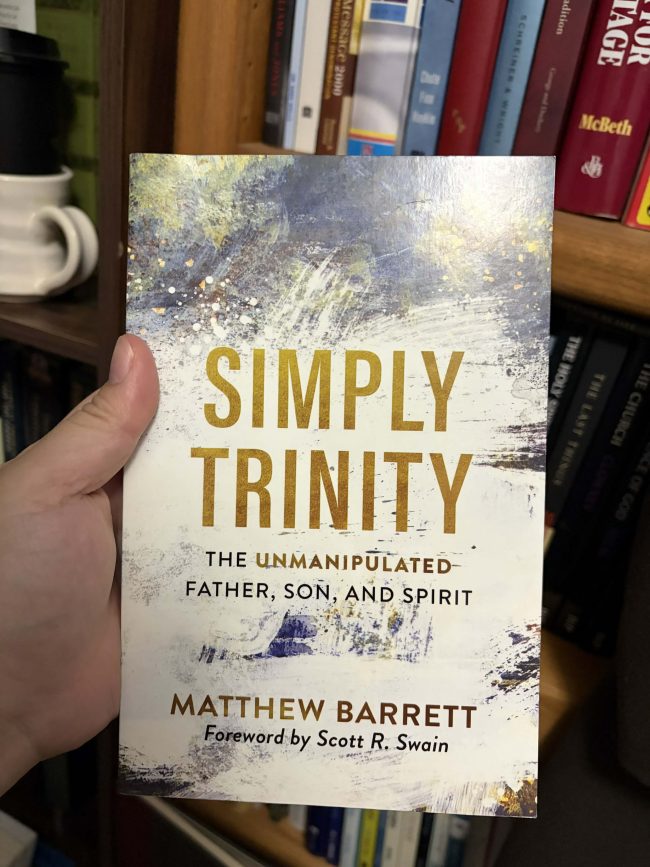
Barrett, Matthew. Simply Trinity: The Unmanipulated Father, Son, and Spirit. Grand Rapids, MI: Baker Books, 2021.
Author’s Bio
The doctrine of God the Trinity, Father, Son, and Holy Spirit, is at the very heart of Christianity. However, Matthew Barrett argues that there has been a drift from the classical understanding of the Trinity. During the time of his work’s publication, Simply Trinity, Barrett was a professor of Christian Theology at Midwestern Baptist Theological Seminary in Kansas, MO. In 2025, he transferred from the Southern Baptist Convention to become Anglican. Currently, Barrett is the Research Professor of Theology at Trinity Anglican Seminary in Ambridge, PA. Additionally, he serves as the Director of the Center for Classical Theology and as the editor-in-chief of Credo Magazine. Most of his publications are on dogmatics, theology proper, classical theology, trinitarian theology, and several works on historical theology.
Back to the Future
His work, Simply Trinity, aims to retrieve the classical doctrine of the Trinity. How does he achieve this? Barrett invites his readers to travel back in time, at least in the last three decades. He surveys and observes that it was during these three decades that the Trinity drift began. While it is helpful to use time travel as a framework, the Back to the Future references somehow limit readers’ imagination, since it was released in the 80s and 1990s. Nevertheless, the point is taken; there is a need to survey the past. Surveying the past three decades reveals the theological landscape of recent years and its influence on the present—and perhaps the future as well. Thus, Barrett insists on doing this, not to blame the specific authors, but to recognize why the Trinity drift has happened and even peaked during the Trinitarian debate in 2016.
In Chapter 1, and by extension in Chapters 2 and 3, Barrett argues that there is a “Trinity drift,” a shift away from a classical understanding of the Trinity. He rightly observes that even in the Evangelical quadrilateral, the Trinity is missing. Also, in the Reformed resurgence among conservative Evangelicals, the Trinity has not been emphasized. Moreover, Barrett identifies significant trinitarian inadequacies in prominent Systematic Theology books from the past, such as those by Wayne Grudem and Millard Erickson. Lastly, in light of the scarcity of Trinitarian theology, he listed the names of theologians and professors who rejected the ancient doctrine of eternal generation (24). The saddest part, according to Barrett, is that most books about the Trinity have been manipulated to further the agendas of socialism, ecumenism, pluralism, environmentalism, egalitarianism, complementarianism, homosexuality, and other related issues (30). In Barrett’s retrieval work, while maintaining to be biblically grounded, he perceives that working alongside the Apostles Creed, Nicene Creed, and the Trinitarian Dream Team, i.e., Athanasius, Hilary of Poitiers, Augustine, Gregory of Nyssa, Basil, Anselm, Thomas Aquinas, Gregory of Nazianzus, John of Damascus, Francis Turretin, John Owen, and John Gill, are the best approach since their interpretations have been tested by the time (see Chapter 2).
Chapters 4 and 5 discuss the divine incomprehensibility and mystery, divine eternality, and God’s revelation. God has revealed Himself as One God in Three persons, Father, Son, and the Spirit. Here, Barrett clarifies that the dichotomy between the economic and immanent Trinity as theological terms is challenging to use. Thus, he prefers divine relations and missions. Eternal and internal relations within the Trinity are ontological; the Father is the unbegotten Father, the Son is the begotten Son of the Father, and the Spirit proceeds from the Father and Son. Missions are reflections of relations, i.e., the Father sends the Son, the Father and the Son give the Spirit to the world. In the latter chapter, Barrett focuses on the theological grammar of divine simplicity. The Trinity is One and Three and is simple. Meaning, God has no parts, no division, no potentiality, and no progression. God is supremely perfect and therefore simple.
Chapters 6 to 8 are primarily devoted to the significance of the doctrine of eternal generation in the eternal relations of origin and its centrality to the gospel. In these three chapters, Barrett demonstrates how the EFS/ERAS teaching contrasts the eternal generation of the Son alongside all its theological implications within the Trinity. For example, in Chapter 8, he focuses on the challenges and theological errors of subordinationism, even if it’s limited to the economic Trinity or functionality. Barrett applies divine simplicity to the eternal generation of the Son in response to the subordinationism view. He said, eternal generation has no division, no priority, no change, not transitive but immanent, and is consubstantial with the Father. Lastly, eternal generation is central to the gospel, as the Son is coequal with the Father.
Chapter 9 focuses on the third person of the Trinity, the Spirit. Unlike the second person of the Trinity, the Son, who had more chapters than the Spirit and the Father, it would have been much appreciated if Barrett also spent more time with the Spirit. For example, he could have discussed the Charismatic or Pentecostal influence in Evangelicalism and their emphasis on the Holy Spirit. Nevertheless, Barrett keeps within his framework on the divine relation and mission aspect of the Spirit in the eternal relations of origin, and ad extra.
In the final chapter, Barrett ends his book by maintaining the unity of the three persons as one God in their inseparable operations. He utilizes the theological term “appropriations and inseparable operations.” He applies it to the work of creation, salvation, and the Christian life, drawing on the insights of several church fathers and Reformers. In his conclusion, Barrett reiterates his thesis, to listen to the past so that Evangelicals can rediscover the “God who is simply Trinity. Unadulterated. Uncorrupted. Unmanipulated” (318).
Recommendation
One of the best aspects of Barrett’s work is how he provides definitions for terms whenever there is theological jargon or unfamiliar words for his readers. This approach makes his work more accessible not only to scholars but also to laypeople. The way he narrates—especially the time travel—and the way he lays out his chapters are also helpful. Each chapter builds on the previous one and points to the next chapter. It seems to have become a natural flow to read through the book and want to finish it in one sitting. Lastly, it is so packed with theological insights, explanations of each doctrine, and its implications on theology and life. Personally, almost every section is worthy of highlighting or underlining for future reference. Again, it’s not a heavy reading, but at the same time, it is comprehensive enough for a primer on the doctrine of the Trinity.
This work is highly recommended for evangelical seminarians, bible school students, pastors, lay pastors, and church leaders. For MDiv and PhD students, this work is a must-read for those majoring in systematic theology, church history, preaching, and even Christian education. Overall, Barrett’s work has achieved his goal of retrieving the classical doctrine of the Trinity to overcome the Trinity drift in contemporary times.
 John&Paul's Reflections
1 John 5:6-7 (KJV)
LikeLike