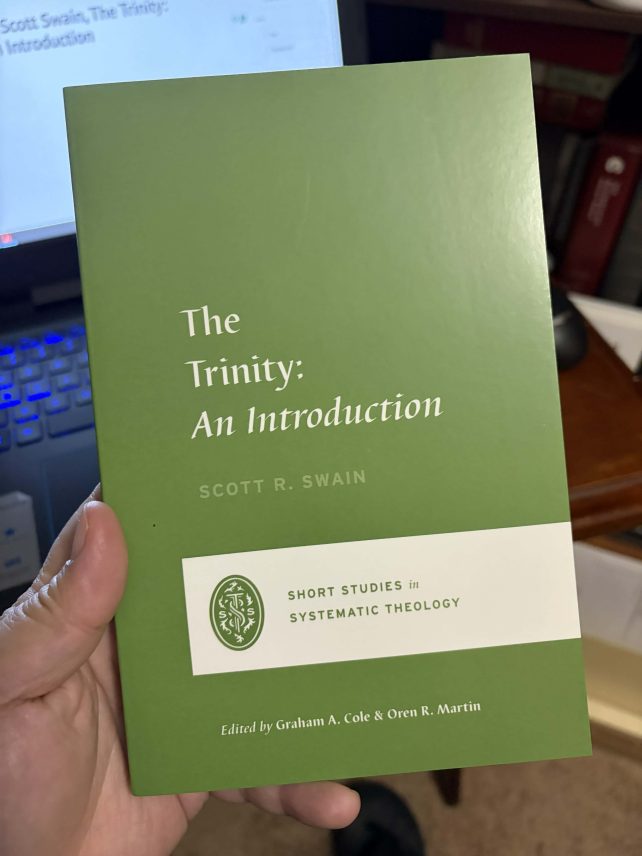
Swain, Scott. The Trinity: An Introduction. Short Studies in Systematic Theology. Edited by Graham A. Colle and Oren R. Martin. Wheaton, IL: Crossway, 2020.
Author’s Bio
Scott Swain is the President and Professor of Systematic Theology at Reformed Theological Seminary in Orlando, Florida. Currently, he is the President-elect and Program Chair of the Evangelical Theological Society. Swain is an ordained minister in the Presbyterian Church in America. Most of his publications focus on themes such as theology proper, trinitarian theology, the theological interpretation of Scripture, and modern Protestant theology. His educational achievements include an MDiv and ThM from Southeastern Baptist Theological Seminary, as well as a PhD from Trinity Evangelical Divinity School.
An Introduction to the Trinity
Christianity’s God is one God in three persons, the blessed Trinity. Christians praise the Name of God and glorify the Triune God in His being and in His works of creation, redemption, and the completion of all things. Scott Swain aims to provide an introductory work for seminary students, laypeople, and pastors seeking to gain a deeper understanding of the blessed Trinity. Swain’s work, while focusing on delivering an equipping and concise Systematic Theology, is catechetical and doxological in its format. Every time he explains a trinitarian doctrine comprehensively, he integrates how Christians praise the Triune God, taking into account the doctrine. Moreover, this systematic work is grounded in the Scriptures to which Swain contends, “The God-breathed Scriptures are the primary discourse of Trinitarian theology” (20). While acknowledging the divinely inspired Scriptures, the language and form were written by humans; thus, they are limited and finite in grasping the fullness of God. There is an infinite gap between God, as Creator, and humans, as creatures. Therefore, Swain approaches this systematic work on the Trinity in analogical language (72). Although his approach is humble and contemplative, Swain is bold enough to rebuke and correct false teachings that reduce and corrupt the doctrine of the Trinity.
He begins with Trinitarian grammar, as outlined in the Scriptures. In the initial three chapters, Swain discusses the Name of God as YHWH and as Father, Son, and Spirit, according to Matthew 28:19. This Name of God is one, yet also three distinct persons. Moreover, only through the relations of the three persons can they be distinguished (50). The Father begets the Son, the Son is the begotten of the Father. The Father and Son spirate the Spirit, the Spirit proceeds from the Father and Son. To clarify the unity and distinction of the persons of the Trinity, Swain introduces the terms common and proper predications. The former refers to the one divine nature of the Trinity as God, which is consubstantial with one another. Likewise, the latter describes what distinguishes the persons from one another in their relations of origin.
Additionally, Swain’s basic grammar of Trinitarian theology includes the doctrine of divine simplicity. God is one. All that is in God is God. In his words, “God is pure God, and nothing but God is God” (54). Simplicity means that there are no parts in God; God is spirit; God is the incomparable One; God is immutable or unchanging because He is; God is self-existing and a se; the first cause, principle with no principle; God is pure act, no potentiality. The Trinity is simple, meaning the three persons should not be understood as three parts, or separate entities, or composing the whole God. The Trinity is one singular God; “Each person is the one God in all his fullness” (59).
Chapters 4 to 6 discuss the persons of the Trinity, the Father, the Son, and the Holy Spirit. He explains how each person is one and the same in substance, but also distinct from the other person. Swain emphasizes the internal relations of the Trinity, or their eternal relations of origin. The Father as the unbegotten who begets the Son; the Second Person as the begotten, and the Son’s eternal generation from the Father; and the Third Person, the Spirit, as eternally proceeding from the Father and the Son. At the same time, how the triune works is indivisible, i.e., the inseparable works. In the chapter about the Son, Swain emphasizes trinitarian errors and heresy about the Son, such as Sabellian modalism, Arian subordinationism, and the modern eternal functional subordinationism or eternal relations of authority and submission. Criticizing EFS/ERAS, he points out where the proponents of this false teaching made their mistake. Swain says that EFS proponents had placed authority and submission in personal properties instead of putting it in the common properties. This mistake also implies that there are three authorities that “effectively deny divine simplicity” (86; cf. 116-117).
Chapters 7 and 8 focus on the trinitarian ad extra, the economy of redemption, and the end of God’s triune work. In this chapter, the inseparable operations of the Trinity are explained in broad and in-depth detail. Swain reminds his readers of the importance of distinguishing between internal actions as ontological or immanent and external actions or works as economic Trinity. It includes themes about the appropriation of work to each person of the Trinity and the divine missions of the Son and the Spirit. The appropriation is assigning a certain work to a certain person, but it is one and single inseparable operation of the Trinity. For example, the Father sends the Son for redemption; the Son accomplishes the redemption; and the Spirit applies the redemption to his children. Appropriation focuses on ad extra. However, the missions in trinitarian language have eternal and temporal aspects. It can be viewed as an extension of the eternal relations of origin toward the temporal uniting and indwelling within his children (114). Chapter 8 closes the book by pointing out that the very goal or ultimate end of the Triune works is the blessed Trinity. All things in this creation by the Trinity are for the Trinity.
In each chapter, Swain concludes with a summary of the specific doctrine discussed and encourages readers to praise the blessed Trinity in accordance with the mentioned doctrine. This work is highly recommended for all Christians who take their faith in the Triune God seriously. Since it has only eight chapters, this short book can be read in a week or once a week with a small group of church leaders. Although brief, Swain was able to define the trinitarian theological terms and even included a glossary for those who require further clarity. This introduction to the doctrine of the Trinity should be on everyone’s bookshelf and is worth re-reading devotionally, at least once a year. More than information about the doctrine, Swain persuades his readers to worship, praise, and glorify the Christian God, the one blessed Trinity.
 John&Paul's Reflections
One thought on “[Book Review] Scott Swain, The Trinity: An Introduction”