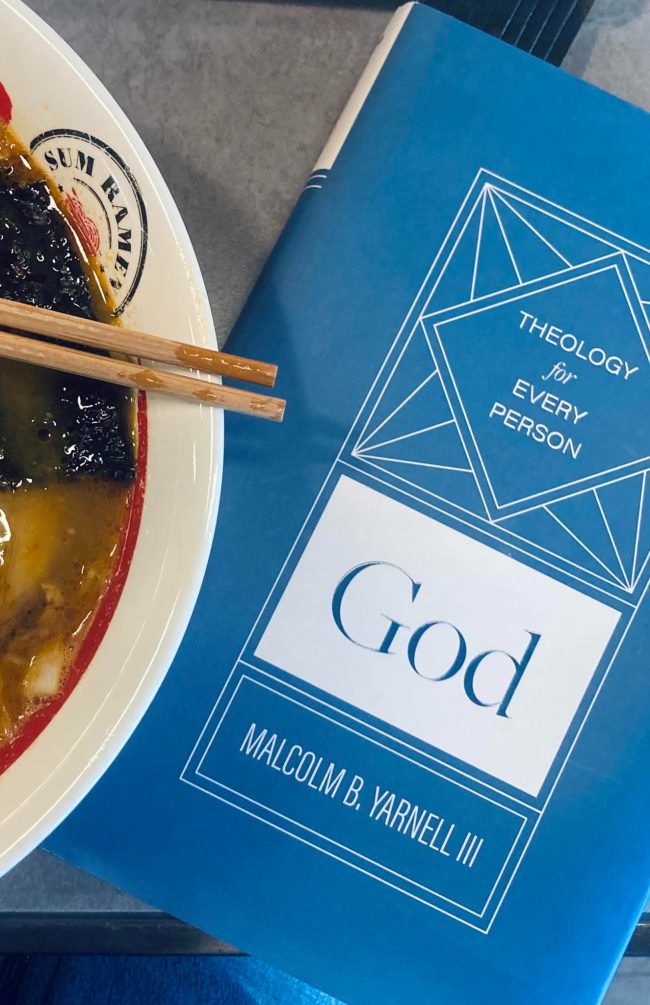
Yarnell, Malcolm B. III. God: Theology for Every Person. Brentwood, TN: B&H Academic, 2024.
Introduction
Malcolm Yarnell III is the Research Professor of Theology at Southwestern Baptist Theological Seminary in Fort Worth, TX. Yarnell earned his PhD from Oxford University in 2000. As a Baptist theologian, he has written several books on biblical theology, the Trinity, historical theology, theological method, and mostly in systematic theology. This book, God, is Yarnell’s recent work on theology proper. It is part of his 3-volume series about God, Word, and Spirit in popular-level dogmatics. Moreover, as a research professor, he is active in numerous theological societies, mentors his doctorate students, and is a part of journal editorial boards.[1] As a minister, Yarnell serves as the Teaching Pastor of the Lakeside Baptist Church in TX.
Yarnell’s aim in this book, God, is to offer a primer on the doctrine of God. He invites his readers on this journey of knowing God. The book is written for all believers, church members, and ordinary Christians. For Yarnell, the term ‘lay person’ carries extra-biblical baggage and can be a damaging concept. Thus, he calls every Christian a ‘theologian’ and every church member a ‘church theologian’ (x-xi).
Synopsis with Critical Review
The book’s preface and introduction display Yarnell’s pastoral heart and missional urgency. Yarnell welcomes his readers with a grand tour of knowing, loving, and worshipping God. He begins by asking his readers to approach the study of God by having faith in Christ. This certainty of faith-seeking understanding is the starting point in the journey of knowing God. This kind of introduction, with an intentional gospel presentation, is quite unique for a work on the doctrine of God. Many systematic theology works begin with the assumption that the readers are already disciples of Christ or church members. While the book is written for believers in Christ and church members, Yarnell asks them to be certain in their faith, prays with them throughout this work, and reminds them of radical humility.
Consequently, Yarnell explores the significance of studying God, starting with the divine economy. He urges his readers to consider what God does and then understand the divine being through the economy. God creates, loves, and reveals his glory. These divine actions are evident in the metanarrative of the Bible: creation, reconciliation, and consummation (23). All these actions point to divine reality, God is love, is holy, and is righteous. The divine reality calls us to respond to worship. Yarnell’s way of writing seems like he is conversing with his readers over a cup of coffee. Not that it is informal, but it reassures that he walks alongside them on this journey.
After this introduction and calls to study God, Yarnell presents divine existence through seven proofs: first cause, design, perfection, worship, conscience, history, and probability. Divine existence organically flows to the knowing of God’s nature and being. It is important to note that whenever Yarnell speaks of knowing God’s reality, it is always in the context of divine accommodation. That is, God, stepping down to the language level of his creatures in his revelation. There is a clear distinction between the Creator and the creature. The reason is divine incomprehensibility. Because God is supremely infinite, eternal, almighty, majestic, and blessed, no finite mind of creature can fathom the fullness of God’s knowledge.
Interestingly, Yarnell moves from divine existence to divine eternality and infinity. God’s existence immediately demands asking, “When and where is God?” But since God is eternal and infinite, divine existence is outside and beyond time and place. By providing this initial answer, readers are compelled to realize how abundant, transcendent, and incomprehensible God is. It is in this context that Yarnell continues to introduce God’s nature. Here, the divine being revealed the Godhead in three persons, known as the Trinity—the Father, Son, and Holy Spirit. Such a difficult doctrine to explain, but Yarnell handles it with carefulness, gentleness, and ease of comprehension. Precisely, his presentation of eternal generation, eternal procession, inseparable operations, and origins is all clear and profound. One special note about this chapter is its presentation of Trinitarian priorities. It does not entail any subordination in the priorities. And by pointing out in the Scriptures, the sequence of the Triune names is interchangeable.
Moving ahead, Yarnell presents God’s nature and attributes in two parts: transcendence and immanence. However, it is significant to keep in mind that whenever one talks about God’s identity, nature, being, and existence, it is but a finite, limited way of describing God. Yarnell puts it this way: every description is a “like” when speaking of the identity of God (95). A similitude—God’s way of stooping down as an accommodation for his creatures. These chapters include the communicable and incommunicable attributes of God. The metaphysical attributes, both negative and positive, are also presented. The former speaks about divine mystery, infinity, simplicity, and aseity; the latter, blessedness, sufficiency, spiritual, and personal.
The second part focuses on the immanent nature of God. Yarnell provides a framework from the Old Testament’s divine holiness to the New Testament’s divine love, with divine righteousness in between. Another special note here is his addition of divine freedom as a communicable attribute to his creatures (123). Doing so entails human freedom, which originates from God but has distinctions and limitations. However, it seems to lack a deeper research agenda or reflection on divine impassibility, without presenting the rationale for the need (122). Overall, these two chapters are excellent introductions to God’s attributes.
The final part focuses on divine revelation or the question, “How do people know about God?” Yarnell presents this through a general and special revelation framework, with an additional chapter that emphasizes natural theology. Grounding in Scriptures through Pauls’ description of divine revelation, Yarnell offers the following: 1) divine work of the Trinity according to the command of the eternal God; 2) centered upon the gospel, the proclamation of Lord Jesus Christ; 3) through the work of the Holy Spirit; 4) reveals divine mystery; 5) through the prophets; 6) for all nations; 7) intended to lead people to the faith; and 8) for God’s glory.
Yarnell’s view, the Theological Interpretation of Scripture, is an excellent takeaway from the succeeding chapters of natural theology and divine revelation. In a word, “TIS grounds itself in lifelong habits of reading Scripture, honors the ancient rule of faith, and incorporates helpful hermeneutical methods from throughout Christian history” (236). Moreover, Yarnell offers a threefold rule of interpretation: the rule of faith, the rule of love, and the rule of hope. Speaking about the rule of hope, only a few theologians or hermeneutics professors emphasize the role of the beatific vision in interpreting the Scriptures.
Overall, this work on theology proper is a must-read for all Christians, especially for church leaders, pastors, and ministry leaders. This book is an excellent primer or textbook for undergrad and master’s students in Bible schools and seminaries. While Yarnell reminds the readers that this work should be read alongside the forthcoming two volumes, it can be read as a single work on theology proper: divine existence, nature, being, identity, and revelation.
[1] E.g., the Southwestern Journal of Theology, the Commission on Baptist Doctrine and Christian Unity of the Baptist World Alliance, the Centre for Baptist Studies in Oxford Publications, and the Journal of the Evangelical Theological Society.
 John&Paul's Reflections
Mine.
LikeLike